The Hidden System

Throughout the series we’ll explore why funding cuts aren’t just about money. Rather, they reveal how science is prioritized and shaped in the modern world and why we should care.
What Happens When Research Funding Gets Cut in Half?
After decades of work trying to understand the complex mechanisms behind Alzheimer’s disease scientists have made outstanding breakthroughs. As recently as last year, significant progress has been made in:
Diagnostic blood tests
Therapies targeting amyloid plaques
Early detection using AI
Gene editing

These findings could have profound impacts on the prevention and treatment of one of neuroscience’s most elusive mysteries. Yet, funding for this work was just cut by nearly 50%. It’s a jarring contradiction: progress accelerating on the lab bench while resources deplete.
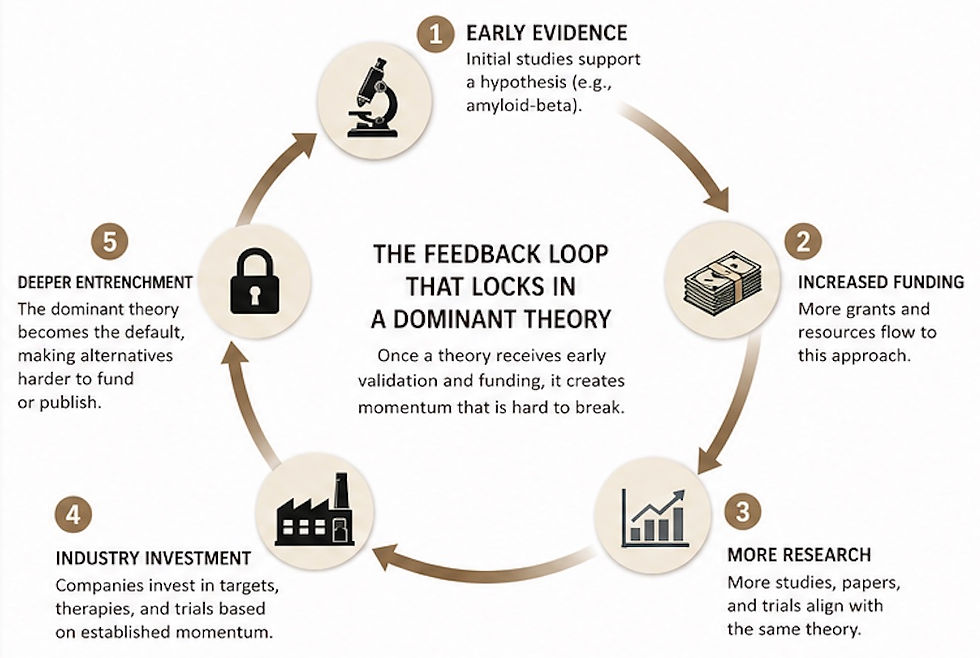
This begs a pressing question: What determines which science moves forward – and which gets left behind?
What’s at Stake?
Alzheimer’s research extends beyond the pursuit of science. As the population ages, more people are at risk, and the financial toll of care is staggering. According to this report, the cost of dementia in 2025 was estimated to be $781 billion. Not only is this a substantial economic load for the United States, but every delay in research translates to delayed treatments, prolonged suffering, and billions in societal costs.
Alzheimer’s is just one example of what’s at stake when funding gets cut. We need to treat scientific research for what it is – a direct insight into our world’s most pressing challenges. Whether in public health, energy, or the environment, policy is shaped by the fundamental science that directs our attention toward where the funding should go.
Where Things Gets Complicated

Funding decisions aren’t made in a vacuum; they’re shaped by a tangle of factors. Budget constraints limit how much money is available. Using the example above, NIH funding cuts have significantly delayed public health research, including Alzheimer’s. Although the financial burden of Alzheimer’s is high, progress is restricted to the small amount of funds allocated to support it. Political priorities influence which areas get more attention. Aside from contributions from private institutions, the majority of funding is reserved for the issue that is most critical in the eyes of the current administration. As of now, we observe a shift from public health towards energy, military strategy, and artificial intelligence. Finally, administrative and regulatory layers add further complexity and cost. The more we “run things up the chain”, the more susceptible the research is to outcome reframing and cost realignment.
It’s not about a single “culprit” cutting funding, but rather a system of competing priorities, each with legitimate stakes.
The Unexpected Tradeoffs
Behind every funding decision are tensions:
Speed vs. Inclusivity: fast breakthroughs may not generalize across populations and could even happen at the expense of equality across socioeconomic parameters.
Innovation vs. Broad Applicability: deep dives can lead to scientific advancement that may not address immediate public needs. Radical discoveries often risk irrelevance if they can’t be applied widely.
Risk vs. Accountability: high-risk projects need oversight, which slows things down.

As the public, we have a unique opportunity to hold science to a certain standard. Finding a balance among these factors ensures that applicable and ethical research is conducted while striving toward scientific achievement.
The consequences of funding cuts are concrete. And in the case of public health research, the results are clear:
Clinical trials are paused or abandoned.
Research continuity suffers as projects stall midstream.
Talented scientists leave the field due to uncertainty.
Translation from discovery to treatment slows.
Cuts are never just numbers on a budget – they often represent slow hope for patients waiting for progress.
Reframing the Question
Instead of asking, “Why was funding cut?”
We should ask: “How should scientific progress be prioritized under constraint?”
It’s not about the size of the budget alone, but how you use it. Science doesn’t operate independently. It is shaped by incentives, institutions, and countless decisions behind the scenes to minimize resources while maximizing outcomes. Alzheimer’s research is just one example of a broader reality: progress is as much a product of policy and tradeoffs as it is of curiosity and genius. Understanding the hidden system behind research funding helps us see why some breakthroughs flourish while others quietly fade away. The only way to redirect the conversation is to be a part of it. Follow along this series to take a closer look at how policy is shaping the future of science.
Sources:
Comments